Friday, July 1, 2011

My analysis of OHBM 2011 abstracts

As the past chair of the Organization for Human Brain Mapping (which just ended its 2011 meeting in Quebec City), I was tasked with giving the "Meeting Highlights" talk which traditionally closes the meeting.  It's a pretty daunting challenge to summarize an entire meeting with such little time for preparation, so I took the tack of doing lots of mining on the full text of the abstracts prior to the meeting.  My entire wrap-up talk is available here; below I present the main results of my text mining, along with some additional analyses that didn't make it into the talk.

Overall meeting stats:

Number of Abstracts 2230
Number of Unique Authors 7622
Mean # of abstracts/author 1.64 (max=33)
Mean # of authors/abstract 5.6 (max=41)

Authorship distribution:

The OHBM is known for being an international organization, and the authorship data confirm this.  In order to visualize the authorship data, I used the Google Maps API to identify the latitude/longitude for each affiliation in the authorship list. This was successful for more than 90% of the abstracts.  These latitude/longitude values were uploaded into Google Fusion Tables, from which I exported a KML file  (available here) which I then opened in Google Earth.  (That's a lot of Google!)

Using Google Earth I then created a tour that circled the globe, showing all of the author locations on a path from Quebec City to Beijing (location of the 2012 meeting).  Here is the video:


Each red pin represents the location of an author at the meeting.

Authorship networks:

Using the abstracts I created a coauthorship network and did some basic analyses on this network (using the Networkx toolbox in Python and the Network Workbench).  The code and an anonymized version of the graph (in graphml format) are available via github.  Here is an overall view of the network:


This shows one giant connected component with 4600 authors (60.3%), along with a large number of much smaller components (the second largest component had 103 authors).  Focusing in on the giant component, here is the spring-embedded visualization:


Here are the network statistics:

Clustering coefficient 0.88
Average degree 8.10
Average shortest path length (giant component only) 6.96
Maximum shortest path length 18
Modularity (giant component only) 0.92


Here is the degree distribution plotted in log space, with a degree distribution for a matched random graph for comparison:


The degree distribution has a long tail compared to the random network, which is what one would expect from this kind of network (for background on this kind of analysis, see Mark Newman's paper The structure of scientific collaboration networks).

Using PageRank centrality, I identified the 10 most central authors in this network (listed with number of abstracts and centrality value):
  1. Paul Thompson (33 abstracts: 0.002020)
  2. Vince Calhoun (21 abstracts: 0.001816)
  3. Arno Villringer (23 abstracts: 0.001756)
  4. Arthur Toga (30 abstracts: 0.001625)
  5. Yong He (19 abstracts: 0.001416)
  6. Peter Fox (26 abstracts: 0.001381)
  7. Michael Milham (24 abstracts: 0.001340)
  8. Alan Evans (16 abstracts: 0.001318)
  9. Robert Turner (23 abstracts: 0.001292)
  10. Daniel Margulies (13 abstracts: 0.001194)
Content analysis:


Using the full text from the articles, I created several tag clouds (using Wordle) to show different aspects of the content.  The first was created from the entire abstract text after filtering out standard stop words along with anatomical regions and author names.


The second was created using a count of all anatomical terms (from the PubBrain anatomical lexicon):


The third was created using a count of all of the terms in the Cognitive Atlas lexicon of mental concepts:


These tag clouds give a good overview of the major topics at the meeting.


If you have other ideas for mining of these data, let me know and I'll give it a try. I have also done topic modeling using latent Dirichlet allocation, and may get around to writing about that in the future.

Thursday, June 30, 2011

Recent Reads

Here are my thoughts about some books I have read recently.

Hits:

The Emperor of All Maladies: A Biography of Cancer:  An absolutely fascinating book.  It traces the history of cancer and its treatment, highlighting all of the ways in which medical science has gotten things wrong in the past and how cancer treatment has only recently evolved beyond blindly poisoning the body.  Not a lot of scientific content, but more than enough to keep me interested.  

Food and Western Disease: Staffan Lindenberg is a physician from Sweden who is best known for the Kitava Study.  This book is a systematic review of the evidence regarding dietary causes of western disease such as cancer, diabetes, and heart disease.  He's clearly an advocate for the paleo diet, but he seems pretty fair in saying when the evidence does or does not fit with that approach. Definitely worth reading.

The Queen of Fats: This is a relatively obscure book from a university press, but turned out to be a great read.  The writer is not a scientist but does a decent job of covering the science, while still making the story engaging and fun.  It has definitely changed how I think about food.

The Immortal Life of Henrietta Lacks: I found this book fairly engaging, though it was a bit too tilted towards the drama of the writer's journey versus the story itself.  What I found most interesting were the stories about how absolutely messed up the Lacks family was (e.g., the children were all partly deaf due to a combination of inbreeding and neurosyphilis).  However, I would have liked more scientific content.  I would definitely recommend this book as background for human researchers as it really highlights the reasons why we have such strict control over human research today.

Superbug: The Fatal Menace of MRSA:  I know that I am crazy for reading these kinds of books as they just make one paranoid about infections, but nonetheless I found it really engaging and interesting.  Not for the squeamish or hypochondriacal, however.

Do The Work:  This is a motivational book targeted largely at writers, but would be really useful for many researchers to read.  It discusses how we often get in our own way, and how to get around it.  It's definitely a different kind of book from the rest of these, but for anyone who is having trouble getting things done I would highly recommend it.

Misses:

The Information - A History, A Theory, A Flood:  This book is about the history of information theory, and thus will appeal to my geekier friends.  Gleick is a great writer, and it starts really strong and does a good job of explaining lots of concepts, but I thought that the end fell really flat.  I would recommend only if you are really seriously interested in the topic.

Bossypants:  I am generally a big Tina Fey fan and I really wanted to like this, but it just didn't work for me.  I made it about 1/3 of the way in before I gave up.

Everything is obvious: *once you know the answer:  I absolutely loved Duncan Watts' earlier book, Six Degrees,   so I was really excited to read this.  In addition, the topic is really fascinating and ripe for the picking.  However, I was really disappointed and barely made it through a couple of chapters.  The problem is that it's written for executives, and thus is peppered with dumbed-down examples without enough deep explanation.  I think it's a great example of how not to write a popular science book.

Sunday, April 10, 2011

why I cut the carbs

The last few months have seen a fairly major transformation in what I eat, with pretty amazing results.  For the last ~20 years my diet has been mostly vegetarian + seafood, and my weight has been very steady, between 160 and 170.  I have always been a major sugar fiend, with my college-age penchant for Skittles morphing into a significant chocolate habit in the last few years.  My exercise habits have always been hit-and-miss, until the last year when I became much more regular in my workouts, which at this point I am doing 6-7 times a week.  Despite this substantial increase in my exercise frequency, I didn't really see any changes in my body composition.  I felt better, but the fat around my belly just wouldn't go away.

My first step on the road to a new diet was my personal trainer's suggestion that I increase the protein in my diet, after I complained to her that all of my work in the gym was not showing results on my body. As I began to change my diet to include more protein, I also discovered Gary Taubes for the first time, and read Why We Get Fat followed by Good Calories, Bad Calories.  Taubes is a writer for Science magazine who has spent the last few years digging into the science of weight loss, and his books are pretty startling because they call into question nearly everything that we think we know about what is good for us.  In short, he argues persuasively that there is no scientific evidence for the common belief that saturated fat and dietary cholesterol are the causes of heart disease, and he also provides a clear physiological explanation for why carbohydrates are the thing that make us fat, as opposed to the "calories in, calories out" idea that most of us have (I certainly did).  In addition, he points out evidence that carbs not only make us fat, but also may contribute to other "diseases of civilization".  Most interestingly, he discusses work that I had not been aware of that links Alzheimer's disease to insulin, which is driven by carbohydrate intake.

The Taubes books really pushed me to rethink what I eat, and I decided to take the plunge and cut carbs from my diet as completely as possible.  I've been pretty successful at this, and the results have been pretty amazing.   I am down to 150 pounds since cutting carbs from my diet, which is pretty impressive given that my weight has never fluctuated more than about 5 pounds from my long-term average of 165, despite pretty radical changes in caloric intake across the years.  I can see the difference too; the fat around my belly is noticeably reduced, as well as in other places around my body.

Perhaps the biggest change for me was starting to eat meat.  I still don't eat much meat, and when I do I try to make sure that it was produced as naturally and ethically as possible, but nonetheless I am now eating meat several times a week (mostly bacon or proscuitto), as well as eating eggs almost every day.  I was very curious to see how this affected my cholesterol numbers when I went for my annual checkup this year, a few months into the new diet.  The results were pretty astounding:

Total cholesterol:  234 (2010) to 199 (2011)
LDL: 147 (2010) to 121 (2011)
HDL: 57 (2010) to 65 (2011)
Triglycerides: 148 (2010) to 64 (2011)

Obviously it's hard to know how much of this to attribute to diet and how much to other factors such as exercise, but these are the best numbers I've ever seen in my life, after years of being a vegetarian. I also don't put too much stock in these numbers; as Taubes points out in his books, the science connecting cholesterol levels to heart disease is pretty weak, except at the extremes.  However, my triglycerides, which are probably much more important, are clearly off-the-charts better after years of being right at the borderline of too high.

I'll write more soon about the interesting experience of deleting some seriously addictive foods from one's diet.

Saturday, January 1, 2011

Goals for the new year

Although I've never been a big fan of new year's resolutions, I do like to set some goals at the beginning of the year so that I have measureable objectives to strive for.  

My main goal for 2010 was to exercise at least 4 times a week.  That was difficult during the spring because I was traveling a ton, but since August I have done a pretty good job of exercising 5-6 times a week.  The main thing I have done to accomplish this is to make going to the gym a daily morning ritual.  It can be very hard to make myself go to the gym if I've not been doing it regularly, but once I'm in the habit then it doesn't really take much gumption to get myself there.

A second goal, somewhat harder to quantify, was "say no more often."  I apologize to those of you who might have borne the brunt of this goal, but I think I have been rather successful.  I said no to a number of talk invitations, skipped two conferences (SFN and MDRS), and have refused an increasingly proportion of review requests.  Then again, there were a lot of things I did not say no to, reflected in the fact that I flew more than 100,000 miles in 2010 (hello Platinum Status!)

For 2011 I am setting three new goals.  

Work toward a travel moratorium for 2012.  I have traveled a lot in the past few years, and 2011 will be no different.  I love traveling and have learned to deal with the stresses of air travel.  However, the physical toll of heavy travel can be substantial, because it makes it very hard to keep up my exercise routine and also makes it hard to stick to a healthy eating plan.  I will never be able to go a year without any travel, due to my various professional responsibilities.  However, the majority of my travel is elective, in the sense that I could say no without greatly harming my career.  During 2011, my default answer for any invitations to travel during 2012 will be "no".  

Improve climbing skills well enough to lead climb.  One big revelation for me in 2010 was the fun of rock climbing, which one of my friends has been kind enough to introduce me to over the last couple of months.  So far I have only done "top rope" climbing, where someone else (the "lead climber") first ascends the face and puts the rope in place from the top, and then I climb the same route.  By the end of the year I would like to be able to lead a route myself, which will require a combination of climbing skill and nerves (since one can fall much farther while lead climbing compared to top rope climbing).  

No new web projects.  Over the last few years my students and I have started a number of web projects.  Some of these, such as The Cognitive Atlas and PubBrain are fairly well established and get a decent bit of traffic, while others such as fmrimethods.org have languished.  In 2010 I started openfmri.org which is a project to support sharing of raw brain imaging data; this project requires a good bit of work because the data have to be organized and validated.  For 2011 I am placing a moratorium on new web projects, so that I can focus on the projects that I already have in place.


Wednesday, December 15, 2010

on carbon footprints and biased judgments

I recently bought a new SUV.  I was in the market for a new car, and really liked the styling of the Toyota FJ Cruiser, not to mention its utility for carrying all the various stuff that I need to carry.  When I announced my purchase on Facebook, it occasioned a number of humorous jabs from my friends, which I was sure that I deserved; after all, I had just bought a monstrous gas-guzzler (17 MPG in town, 21 on the highway)!

These comments also inspired me to think more about how we judge the impact of our choices on the environment. Everyone knows that driving a fuel-efficient, low-emission vehicle is better for the environment than a gas-guzzler, because this issue is prominent in the news as well as car advertisements.  However, a large body of psychological research has shown that our judgments about things like this are often biased.  Rather than basing our judgments on statistics (as we should if we want them to be accurate), we often use rules of thumb, or "heuristics" as they are known in psychology.  For example, when asked to judge how common something is, we often base our judgments on how readily an example of it comes to mind.  This "availability heuristic" is the reason why people's judgments about the prevalence of crime often don't match crime statistics; even when crime is going down, news reports of criminal acts easily come to mind and bias us to think that crime is actually increasing.

When it comes to the impacts of our behavior on the environment, the recent popularity of hybrid cars has made the environmental consequences of driving highly available in our mind, and thus we think of driving as a major component of our carbon footprint.  However, some analysis using the various carbon footprint calculators on the web shows that we may be overestimating the relative benefit of buying a fuel-efficient car in comparison to other lifestyle choices that we make.

According to the carbonfootprint.com calculator, my FJ Cruiser will produce about 3.25 tons of CO2 over a year of driving my average of 6000 miles. If I had purchased a Toyota Prius, I would produce 1.17 tons over the same year, a savings a just over 2 tons of CO2.

That sounds like a big reduction in CO2 emissions, but how does it compare to some other choices that we might make?  A round trip flight from LAX to JFK produces 2.41 tons of CO2 per passenger when the effects of water vapor are taken into account.  Thus, a single airline flight obliterates the benefits of driving a hybrid for a year.  Another choice that has a big environmental impact is eating meat.  According to the Nature Conservancy's calculator, eliminating meat from one's diet reduces one's yearly carbon footprint by 3.2 tons; again, more effective than buying a hybrid.

The choice that has the largest environmental impact by far is having children.  According to a study published last year, the lifetime carbon footprint of an American child is estimated to be more than 9,000 tons of CO2.  Thus, the environmental impact of having just one child in the United States is equivalent to 1,450 people each driving a Cadillac Escalade 10,000 miles over one year.  Another way to look at it is that the yearly CO2 savings due to all of the hybrid vehicles sold in the US in 2009 (290,272 according to HybridCars.com) is enough to offset the lifetime carbon impact of about 64 American children.

How can we improve our ability to make accurate judgments in situations like this?  First we need to be aware of our biases, but this is difficult: Research by Emily Pronin from Princeton University has shown that humans often have a "blind spot" regarding their own biases. Research subjects in one of her studies (who were randomly chosen passengers at the San Francisco airport) rated themselves as substantially less biased than the "average passenger."  Once we realize that we are all biased, we can start to try to overcome those biases.  One way to overcome biases is to slow down; when we take the time to take in more evidence regarding a judgment or decision, we are more likely to rely upon information that is less biased than the "gut feeling" that our heuristics provide for us.

Sunday, November 21, 2010

My personal computing history


My generation may be the last to ever have known a world without ubiquitous computing.  It’s now almost impossible to imagine a computer being a thing that sits in the corner at the school library and gets used only by a few geeky kids, but in my high school that’s exactly what it was.  I’ve recently been trying to reconstruct the history of different computers that I played with and owned back in those days; here is my first pass at a personal computing history, helped in large part by the awesome amount of computer history information that’s available online.

My first exposure to computers came during 1981-1983 when I was in high school, though several different paths (the order of which is slightly hazy me at this point). 

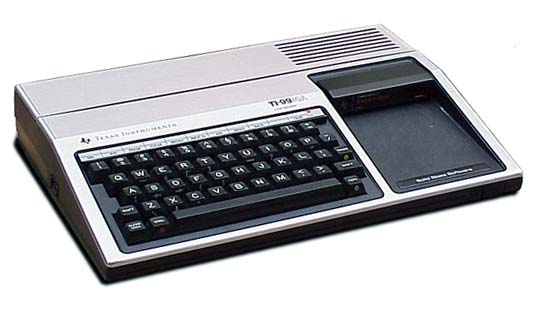
The first system that I remember programming on was the TI 99/4A, which was a “home computer” released in 1981 (we probably got it around 1982-1983).  It came with relatively little software, but I do remember playing a number of games including “TI Invaders” which was their clone of the Space Invaders game.  The programs were released on cartridges, more like a video game system than a personal computer.  The machine came installed with “TI BASIC” which was a pretty rudimentary version of BASIC.  We didn’t have a hard drive, but it was possible to save programs to cassette tape.  I don’t remember much about what kind of programming I did on this system, though I’m pretty sure it was all text-based.

Northstar Advantage

Around the same time, my father purchased a computer for his accounting office, back when this was just becoming common.  It was a Northstar Advantage, which was resold with a GBC logo.  This machine was released in 1982, right after the release of the first IBM PC.  It ran an operating system called CP/M, which was similar to but predated Microsoft’s DOS. The apps that I remember using included WordStar (word processing) and dBASE (a database program). I don’t think I actually programmed on this system, but it was my first experience with command line interfaces (PIP, anyone?).

Apple IIe

In our high school there was an Apple IIe in the library that was almost always free.  I was ostensibly on the tennis team when I was a senior in high school, but given that I wasn’t very good at tennis, the coach was happy to let me go to the library and play with the computer instead.  This system had a great advantage over the TI at home, which was that I could save programs to 5 ¼” floppy disk.  This is the first machine that I remember doing any graphics programming on, though I’m sure that it was incredibly rudimentary.

In the summers of 1984 and 1985, I worked at a local bank helping them to automate some of their records.  The bank had just recently purchased a new IBM PC/AT which was the second generation of IBM PC’s.  It had such amazing features as 16 MB of RAM and a 20 MB hard drive.  I primarily used Lotus 1-2-3 (an early spreadsheet program).  However, in the moments between real work, I would also take advantage of the machine’s modem to dial into a number of BBS sites.  It’s hard for me to remember exactly what I found on these sites or how I even found out about them, but it was basically like a very earlier version of the web that one could call into for free.  I think I mostly used them to download software.

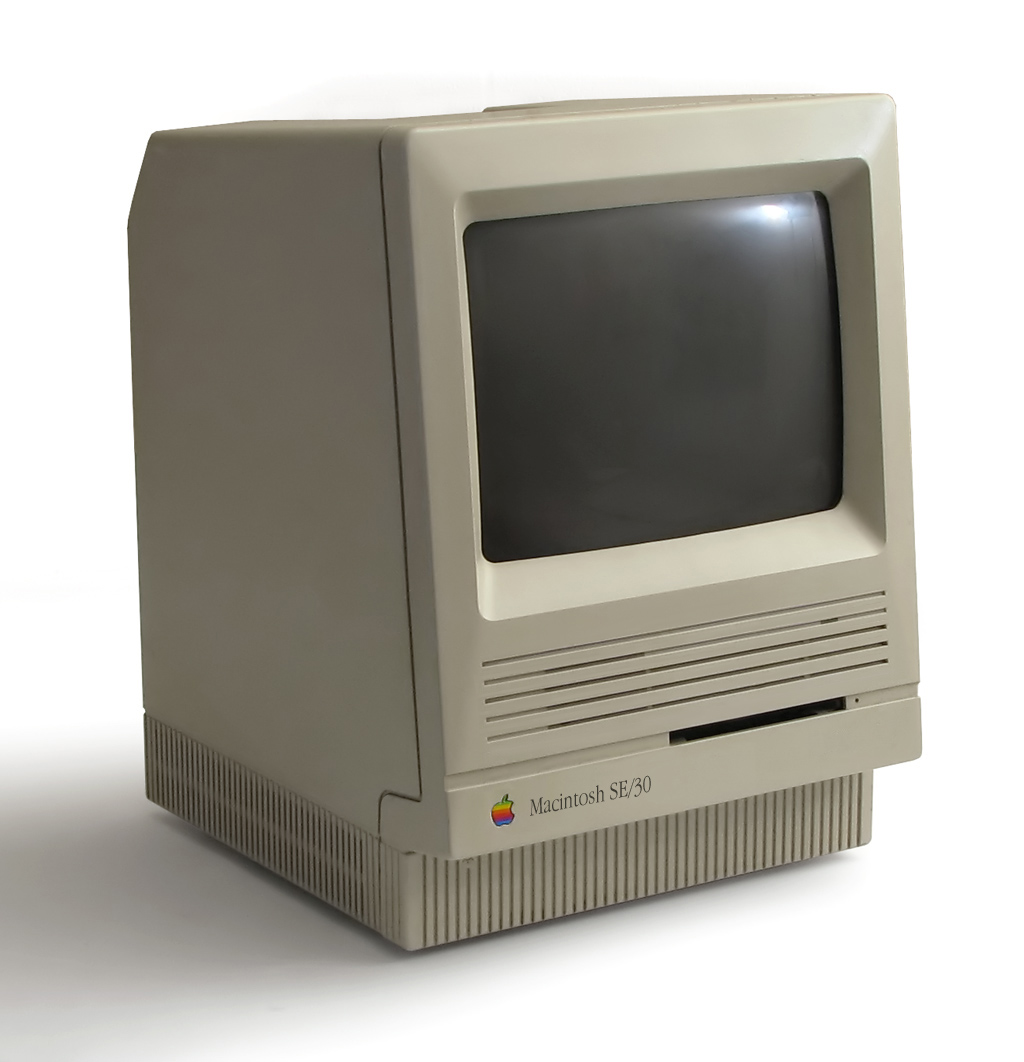
Macintosh SE/30

During most of my college career I did not have my own computer; very few students did. If we needed one, we would go to the computer lab on campus, which is where I was introduced to Macintosh (Plus or SE) computers.  In my senior year of college the Mac SE/30 was released, and my parents were nice enough to plop down several thousand dollars to buy me one before I headed off to graduate school, along with an ImageWriter II dot-matrix printer.  This machine was my workhorse throughout graduate school.  I addition to writing papers, I was my platform for learning other languages including PASCAL and C.  It was the system on which I wrote my first simulations, which would be published here (though the actual simulations for that paper were run on a Sun UNIX system at the Beckman Institute because it was so much faster than my SE/30). 

PowerTower Pro

When I arrived at Stanford for my postdoc in 1995, it was definitely time to upgrade.  I was lucky enough to be in the market during the short period in which Mac clones were available, and I bought a Power Computing Power Tower Pro, which was one of my favorite computers ever.  It was this machine on which I first started playing serious with Linux (using mkLinux IIRC). The PowerTower Pro is the last machine that I’ve owned that I think could be legitimately called “historical”, so that’s where my story ends for now.


Saturday, November 13, 2010

Becoming an academic road warrior


It’s a reality that if you want to make it in academic science, you have to be ready and willing to travel a good bit.  Between conferences, talks at other universities, grant review panels, and other various events in the US and abroad, I generally end up flying between 50,000 and 100,000 miles a year.  Students and postdocs often ask me how I can stand to travel so much, and this post will lay out some of the strategies that I use keep myself sane while on the road.  I should note up front that many of these strategies are not exactly “budget travel” ; my feeling is that I travel enough that it’s worth investing in some things that make it pleasant, but I realize that this may conflict with the realities of student or postdoc salaries.

Pick an airline and stick with it

I think that airline loyalty is probably the most important thing one can do to make traveling more pleasant.  Most airlines have loyalty programs for people who travel at least 25,000 miles (that’s about 5 rounds trips from LA to DC, for example), and achieving this level of frequent flyer “status” comes with some very nice benefits.  Foremost is access to priority check-in and priority security lines.  The benefit of priority security varies between airports, but in many places (like the United terminals at LAX or O’Hare) it can save a very long wait to get through security during busy times.  As your status increases, so do the benefits; in particular, once you reach “gold” status (50,000 miles on most airlines) then you become much more likely to get upgraded to first class, which is always a nice perk.  Some airlines (like United) give preferred seating (with extra legroom) to frequent flyers, which makes using your laptop much more bearable.  Another benefit is that you have priority for rebooking when problems occur.  Finally, another benefit of loyalty is that it gives you a chance to learn the airline’s terminals and systems, which can be really useful when you are running late or things go wrong.

I was a frequent flyer with United for many years, but recently switched to Continental after moving to Austin – I’ve been quite happy with both overall, and fortunately with their merger these are becoming one airline. 

When another institution invites you to come and give a talk, it’s perfectly legitimate to tell them what airline you want to fly on (and even what flights you want to take), and give them your frequent flyer number.  This has the nice side benefit that your itinerary will show up on the airline’s online system, so you can see schedule changes and check in online.

Be sure to sign up for text alerts from your airline, which will let you know about delays or upgrades.  Also, when problems arise, it’s often better to call the airline directly rather than waiting in line to speak to a customer service representative when the lines are long.

Join the club

If you’ve spent any time in airports you have probably wondered what goes on inside the “Red Carpet Club” or other airline lounges.  The short story is that it’s a place where you can pay to get away from the craziness of the terminal, and if you are going to fly regularly it is money well spent.  It’s not cheap (generally about $400/year) but if you are flying 20 round trips in a year then that’s just $10 for each one-way trip – well worth the price IMHO.  Perks include free wi-fi, snacks, and drinks (usually just beer) – unless you are in a European airport, where it generally includes a full spread of food and a full bar (though not always free wi-fi).   But perhaps the most important benefit of the club is that there are customer service representatives that can help with flight problems – this is especially useful when large disruptions occur due to weather, resulting in long lines at the customer service desks out in the terminal.
 
Keep calm and carry on

NEVER check a bag unless you absolutely have to. It is certainly possible to travel for weeks with just a carry-on bag, if you pack carefully and take advantage of hotel laundry services while on the road.
I have two bags that I use for most of my trips.  My primary bag for trips longer than 2 days is a 21” expanadable carry on.  I find that I can generally make it up to 4-5 days with this bag in its carry-on (un-expanded) configuration, depending on the season and what kinds of clothing I have to carry.
For 1-2 day trips I use a small carry-all. 

Learning to pack can help you really maximize your carry-on space - for example, see (Packing Tips from Professional Travelers) - I particularly find that rolling my clothes helps to maximize packing density.

Once you can afford it, buy some good luggage.  I use Briggs & Riley, which is not cheap but has a lifetime warranty and has very good usability in general.  Nothing sucks more than luggage failure in the middle of a trip.

I also carry a TSA-approved laptop bag; having to remove your laptop is a pretty small thing, but every little bit counts when it comes to getting through security without stress.

Stay prepared

I don’t want to have to scramble the morning of my flight to find all of the toiletries that you need to take with me, so I have a separate set of toiletries that I keep ready just for travel.  I use either 2 ounce Nalgene bottles or recycled pill bottles to hold most of my toiletries, so that I can fit everything into the TSA-approved quart bag.  

Some things I always bring:
  • extra ziploc bags
  • earplugs (for the plane and/or the hotel)
  • noise-cancelling headphones (I use the Sennheiser travel headphones which are are small and light)
  • an energy bar (in case I miss the chance to eat between long flights)
  • my yoga mat (to keep me flexible after too much sitting - I have a very thin and light mat that's easy to pack)
  • for international travel: Ambien (for sleeping on the plane and overcoming jet lag)